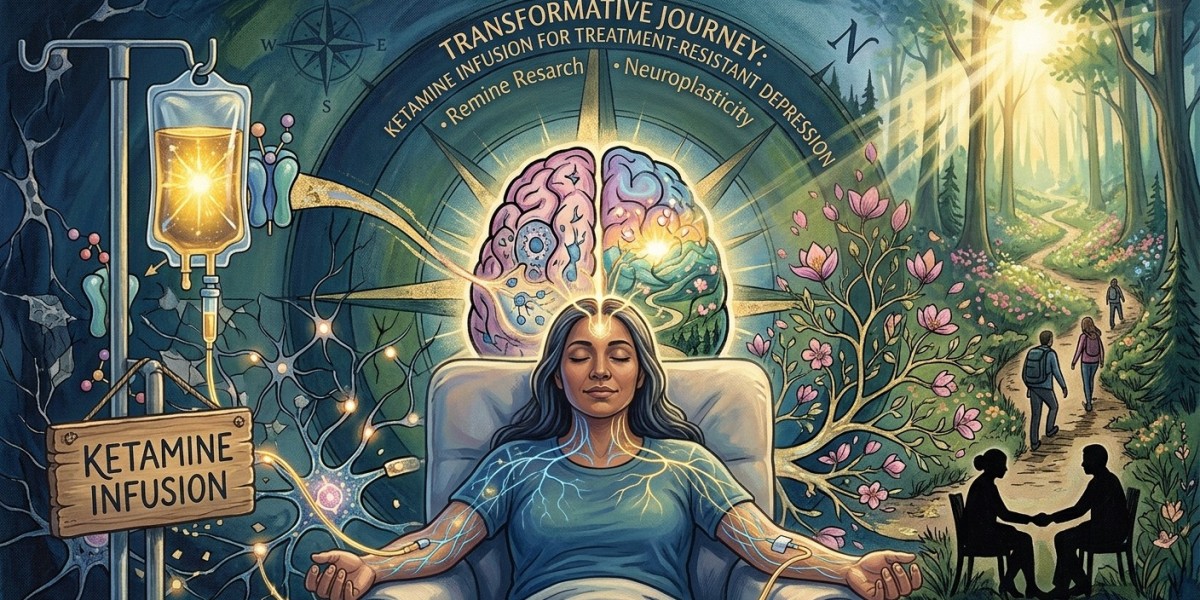

Picture trying medication after medication for years, and still waking up under the same heavy fog. For millions of people, that is the reality of treatment-resistant depression. This is exactly where Ketamine Infusion Therapy has carved out a remarkable place in modern psychiatry, offering rapid relief when nothing else has worked. It is not a trend or a quick fix. It is a clinically studied option that is changing outcomes for some of the hardest-to-treat patients in mental health care.
The need is enormous. Depression affects roughly 280 million people worldwide, and about 30% of them have treatment-resistant depression, meaning their symptoms persist despite trying at least two standard antidepressants (WHO; PMC, 2025). For these patients, waiting weeks for a pill that may never work is not just frustrating. It can be life threatening.
What Makes Treatment-Resistant Depression So Hard to Treat
Treatment-resistant depression, or TRD, is depression that does not improve after two or more adequate antidepressant trials. It is more common than most people realize, and it carries a heavy toll.
A few reasons it is so stubborn:
Traditional drugs target one system. SSRIs work mostly on serotonin, which does not help everyone.
The timeline is brutal. Standard antidepressants can take four to eight weeks to show any effect.
Trial and error wears people down. Each failed medication means more lost time, often during a crisis.
When the usual tools keep failing, a fundamentally different approach is needed. That is what makes infusion therapy worth understanding.
How Ketamine Infusion Therapy Actually Works
Ketamine Infusion Therapy delivers a low, controlled dose of ketamine directly into the bloodstream, working on the brain's glutamate system rather than serotonin. This different mechanism is why it can succeed where other treatments stall.
Here is what the standard protocol looks like:
Subanesthetic dose. Around 0.5 mg/kg of ketamine, far below surgical levels (Psychiatry Research, 2024).
Slow IV delivery. The dose is infused over roughly 40 minutes while vitals are monitored.
A series, not a single shot. Most programs use about six infusions over two to three weeks, followed by maintenance as needed (clinical consensus, 2021).
The reason for a series is the cumulative effect. Instead of one burst, repeated infusions help the brain build and strengthen new connections over time. Relief can begin within hours of a session, a dramatic contrast to the weeks pills demand.
What the Research Shows About Results
The evidence behind Ketamine Infusion Therapy is genuinely encouraging, especially for people who have run out of options. These are not vague promises, they are measured outcomes.
Consider the data:
In the open-label Bio-K study, 52% of 74 patients with treatment-resistant depression reached remission after just three infusions over 11 days (Bio-K Study).
A five-year real-world study of 71 outpatients found that roughly 55% responded to IV low-dose ketamine, with side effects that were transient and mild for most (Psychiatry Research, 2024).
The benefits extend further. In one trial of veterans with PTSD and depression, 80% were in remission from PTSD symptoms 14 days after a six-infusion course (PMC).
Results do vary, and honesty matters here. Not everyone responds, and effects can fade without maintenance. Still, for patients who have failed multiple medications, those numbers represent real and meaningful hope.
What to Expect During a Session
Ketamine Infusion Therapy happens in a controlled clinical setting, never at home, and the structure exists for safety. Knowing what is coming makes the experience far less intimidating.
A typical session includes:
An IV line placed in your arm, with the infusion running about 40 minutes.
Continuous monitoring of blood pressure, heart rate, and oxygen throughout.
Mild, temporary dissociative sensations, often described as floaty or detached, that fade within an hour.
A short observation period afterward, plus arranging a ride home since you should not drive.
It is worth knowing that IV ketamine for depression is used off-label, while its cousin esketamine (Spravato) is the FDA-approved nasal spray version. Both come from the same scientific foundation, just delivered differently.
Conclusion
Ketamine Infusion Therapy has opened a real path forward for people whose depression refused to respond to anything else. By targeting glutamate, working in hours instead of weeks, and building on a series of supervised treatments, it offers something traditional medicine often could not.
The key takeaways:
Built for the toughest cases: designed for treatment-resistant depression after other drugs fail.
Fast and structured: relief in hours, delivered over a guided series of infusions.
Backed by data: response and remission rates often in the 50% range for TRD.
Always supervised: safe, monitored, and best explored with a qualified provider.
If you or someone you love has tried everything and still feels stuck, this is a conversation worth having with a mental health professional. Recovery that once felt impossible may be closer than it appears.