
Preparing for the AWS Certified Developer Associate exam requires more than completing a collection of practice questions. The certification evaluates applied development knowledge across AWS services, security configurations, deployment mechanisms, and debugging workflows. Candidates who rely solely on repetition often struggle when confronted with scenario-driven questions that test contextual judgment rather than recall.
Smart practice test methods emphasize reasoning, pattern recognition, system behavior understanding, and service interaction clarity. This article explores structured approaches that convert practice testing into a deliberate learning mechanism rather than a scoring exercise.
Understanding What the Exam Actually Measures
The AWS Certified Developer Associate credential validates the ability to develop, deploy, and debug cloud-based applications using AWS services. It does not assess theoretical familiarity with services alone. Instead, it measures applied competence in service integration, configuration accuracy, and troubleshooting logic.
The exam blueprint typically focuses on areas such as development with AWS services, security best practices, deployment pipelines, monitoring, and optimization. Practice tests become effective only when aligned with these functional domains rather than approached as isolated question banks.
A candidate must recognize that scenario-based questions frequently test decision-making under constraints. For example, identifying the most cost-efficient storage option for specific access patterns or selecting the correct IAM policy behavior requires conceptual clarity rather than memorization.
Domain-Based Practice Rotation Strategy
An effective preparation method involves dividing practice sessions according to exam domains rather than taking full-length exams repeatedly. This method strengthens conceptual isolation before integrating skills into complete simulations.
The following table illustrates how domain-focused practice can be structured.
| Practice Phase | Focus Area | Objective | Expected Outcome |
|---|---|---|---|
| Phase 1 | Development with AWS Services | Understand SDK usage, Lambda integrations, DynamoDB operations | Conceptual confidence in application logic |
| Phase 2 | Security & Permissions | Practice IAM roles, policy evaluation, encryption mechanisms | Reduced errors in access-control scenarios |
| Phase 3 | Deployment & CI/CD | Evaluate CodePipeline, Elastic Beanstalk, CloudFormation | Clear understanding of release workflows |
| Phase 4 | Monitoring & Debugging | Analyze CloudWatch metrics, logs, tracing | Improved troubleshooting judgment |
| Phase 5 | Full-Length Simulation | Combine all domains under timed conditions | Realistic exam readiness |
This rotation approach prevents premature reliance on cumulative mock exams while strengthening foundational clarity.
Active Error Analysis Instead of Score Tracking
Many candidates measure progress by tracking rising mock test scores. While improvement can be encouraging, it does not necessarily indicate conceptual mastery. Smart practice methodology requires deep error analysis.
When reviewing incorrect answers, candidates should categorize errors into conceptual misunderstanding, misinterpretation of the scenario, service confusion, or time pressure. Writing short justifications for correct and incorrect options forces cognitive processing beyond recognition. This reflective process reduces repeated mistakes and enhances confidence when encountering rephrased questions.
Simulating Architectural Thinking
The AWS Developer Associate exam often requires architectural reasoning even though it is developer-focused. Practice sessions should therefore include diagram-based reasoning exercises.
Before selecting an answer, candidates can mentally visualize service interactions. For example, when evaluating an event-driven architecture question, thinking through how Amazon SQS integrates with Lambda, or how SNS triggers downstream processing, builds systemic clarity. Candidates who treat practice questions as isolated items may miss relational dependencies among services. Developing architectural intuition transforms practice sessions into system-mapping exercises rather than answer selection drills.
Timed Constraint Conditioning
Time management plays a significant role in exam performance. However, beginning preparation with strict timing can hinder learning depth. A staged timing approach is more effective.
Initially, practice without time limits while focusing on explanation quality. Later, gradually introduce time constraints to simulate pressure. This progression allows cognitive fluency to develop before stress exposure. Practicing full-length simulations only after domain-level mastery reduces anxiety and improves pacing decisions.
Watch Cert Empire’s YouTube video for an easy explanation:
Contextualizing AWS Service Behavior
Many incorrect answers stem from misunderstanding default configurations or service limits. Practice testing should therefore include behavior-based reinforcement.
For instance, understanding eventual consistency in DynamoDB, the retry behavior of Lambda, or the scaling properties of API Gateway clarifies why certain options are preferable. When reviewing practice questions, candidates should identify which service behavior principle the question tests.
Some preparation platforms, including Cert Empire, structure practice environments to align questions with domain logic rather than simple repetition, allowing learners to map errors to functional categories.
Avoiding Memorization Loops
Repeated exposure to identical questions creates false confidence. Candidates may begin recognizing wording patterns instead of interpreting problem statements.
To counter this, rotate question sources periodically. Additionally, rewrite question scenarios in your own words before reviewing answer options. This technique reduces dependency on phrasing and increases comprehension of the underlying requirement.
Another effective method involves reversing the question. Instead of asking why the correct answer is right, analyze why alternative answers are wrong. This builds elimination skills, which are essential for multiple-choice reasoning.
Those looking for a step-by-step preparation framework that aligns domain study with realistic exam expectations can review this detailed resource: https://certempire.com/how-to-pass-aws-certified-developer-associate-exam
Service Interaction Mapping
A practical method for strengthening conceptual clarity involves constructing informal interaction maps during practice review.
For example, when reviewing a deployment question, outline how CodeCommit integrates with CodeBuild, CodeDeploy, and CodePipeline. This mapping builds a layered understanding.
Such exercises train the brain to evaluate architectural fit rather than react to keywords. Over time, this reduces hesitation during exam scenarios that include multiple viable-looking services.
Decision-Making Under Constraints
AWS exam questions often introduce cost, latency, durability, or security constraints. Smart practice sessions should include deliberate constraint identification.
Before selecting an answer, isolate what the constraint emphasizes. If the question prioritizes minimal operational overhead, serverless solutions may be preferred. If durability is central, S3 storage classes must be evaluated carefully.
Practicing constraint identification builds analytical reflexes that accelerate decision-making during the actual exam.
Lifecycle-Based Scenario Practice
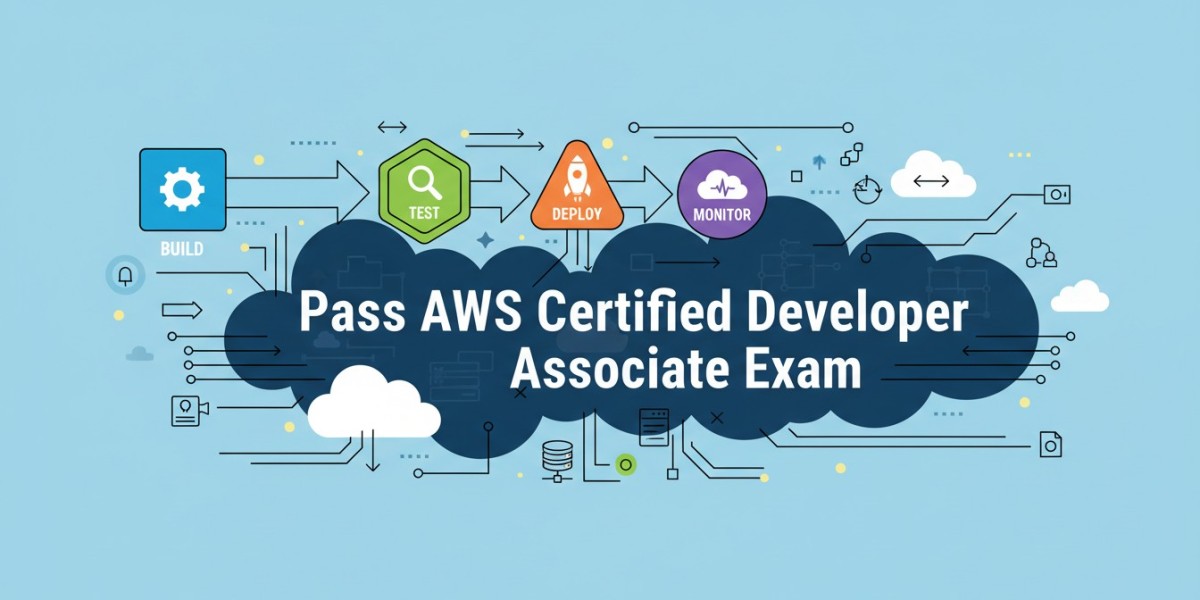
Another effective strategy involves grouping practice questions by lifecycle stage rather than by service. For example, categorize questions into design, build, deploy, monitor, and optimize phases.
This method encourages thinking across the software development lifecycle in AWS. Instead of viewing services independently, candidates understand how they support application maturity over time. Lifecycle-based grouping mirrors real-world development workflows, strengthening contextual reasoning.
Integrating Hands-On Reinforcement
Practice tests alone are insufficient without experiential reinforcement. After encountering a challenging question, candidates should replicate the scenario in a test AWS environment where feasible.
Deploying a Lambda function, creating IAM policies, or configuring CloudWatch alarms reinforces memory through action. When conceptual understanding is paired with hands-on execution, retention improves significantly. This blended method ensures that practice tests serve as diagnostic tools rather than passive learning mechanisms.
Cognitive Stamina Development
The AWS Certified Developer Associate exam requires sustained attention for the duration of the test. Smart preparation includes mental endurance training.
Full-length practice exams should occasionally be taken in distraction-free conditions to replicate exam-day focus. Reviewing immediately after completion maintains cognitive continuity and highlights fatigue-driven mistakes. Building stamina ensures consistent decision quality from the first question to the final one.
Final Thoughts
Passing the AWS Certified Developer Associate exam requires strategic practice rather than repetitive testing. Domain-focused rotation, error categorization, architectural reasoning, and lifecycle-based thinking transform practice questions into analytical exercises. Time conditioning, understanding service behavior, and hands-on reinforcement strengthen conceptual depth. Candidates who approach practice testing as structured skill development rather than score accumulation improve both confidence and decision accuracy. Smart methods create adaptive thinking patterns that align closely with the applied nature of the certification.