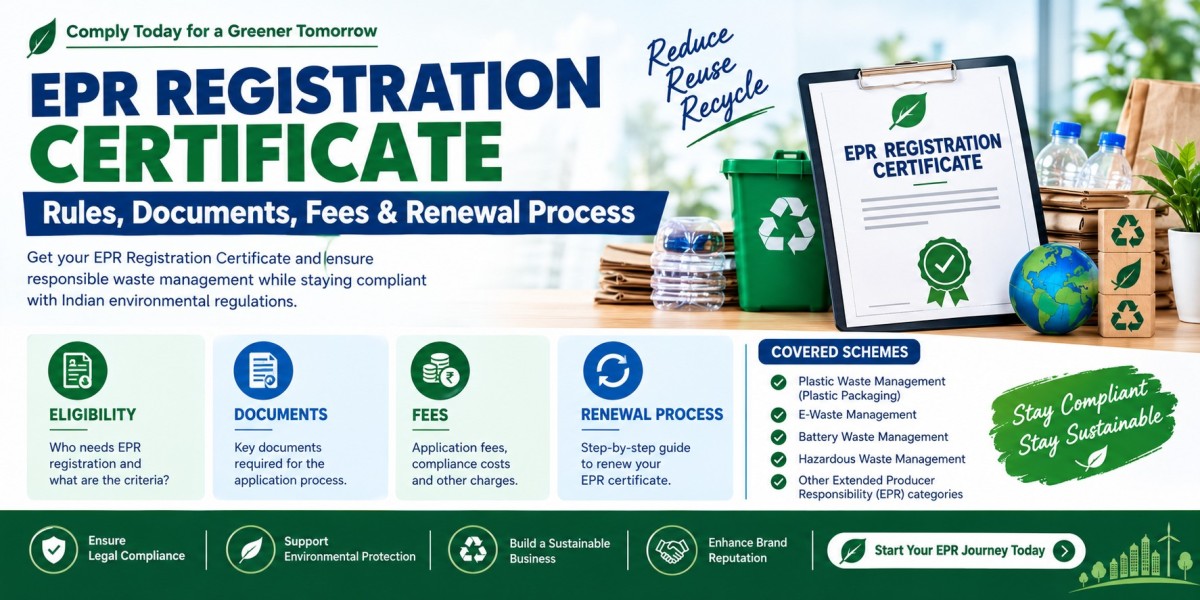

If your business makes, imports, or sells products with plastic packaging, you may have heard about EPR Registration Certificate. EPR means Extended Producer Responsibility. In simple words, it means that businesses have a responsibility to help manage the waste created by the packaging they put into the market.
For plastic packaging, Producers, Importers and Brand Owners (PIBOs) are required to register through the CPCB’s online EPR system and meet their EPR obligations.
What Is an EPR Registration Certificate?
An EPR Registration Certificate is a registration given to eligible businesses under the applicable waste-management rules. It helps the government track how businesses are managing the waste linked to their products.
For plastic packaging, EPR requires businesses to take responsibility for plastic waste through activities such as recycling, reuse or suitable end-of-life disposal.
The CPCB has also introduced a Common EPR Portal for EPR-related registrations. The earlier plastic packaging portal was discontinued from June 28, 2026, with registered data migrated to the new common portal.
Who Needs EPR Registration?
EPR requirements depend on the type of waste and the business activity. In the case of plastic packaging, the framework covers:
Producers
Importers
Brand Owners
Certain plastic raw material manufacturers and importers
Plastic Waste Processors, where applicable
Plastic Waste Processors can include recyclers and other approved processing facilities.
So, if your business puts plastic packaging into the market, it is important to check whether EPR registration applies to you.
EPR Registration Certificate Rules
The main idea behind EPR is simple: the business that introduces covered products or packaging into the market must take responsibility for managing the related waste.
Businesses may have to:
Register on the applicable CPCB EPR portal.
Provide correct business and product information.
Meet the required EPR targets.
Work with registered waste processors where required.
Maintain proper records.
File annual returns and other required information within the prescribed timelines.
CPCB's plastic EPR framework provides for registration, EPR target fulfilment, annual returns and monitoring of compliance.
Documents Required for EPR Registration
The exact documents can depend on the type of applicant and the applicable EPR category. For plastic packaging registration, commonly required information includes:
PAN details
GST details
Company or business registration details
Registered office address
Authorized person's details
Details of products and plastic packaging
Manufacturing or import-related information, where applicable
Supporting documents related to the business
Consent documents for applicable production facilities
The CPCB guidance manual specifically asks applicants to provide legal name, trade name, business type, registered address, PAN, CIN where applicable, and authorized-person details.
It is important that the information and documents submitted on the portal are accurate and consistent.
EPR Registration Fees
EPR fees are not necessarily the same for every business. They can depend on the type of EPR registration, category and applicable rules or fee structure.
For example, the CPCB's published plastic EPR FAQ lists PIBO application fees based on plastic-waste generation slabs:
Below 1,000 TPA – ₹10,000
1,000 to 10,000 TPA – ₹20,000
Above 10,000 TPA – ₹50,000
The same FAQ states that renewal fees were the same as registration fees and annual processing fees were 25% of the application fee. Businesses should check the current CPCB portal and applicable fee notification before applying because EPR requirements and portal procedures can change.
EPR Renewal Process
Renewal depends on the particular EPR category and current rules. Some EPR systems specify a fixed registration validity period. For example, CPCB's waste-tyre registration instructions state that registration is valid for two years and should be renewed after that period.
For your business, the basic renewal process generally involves:
Checking the validity of your registration.
Logging into the applicable EPR portal.
Reviewing existing business information.
Updating details if required.
Uploading required documents.
Paying the applicable renewal fee.
Submitting the renewal application.
Completing any additional compliance requirements.
Always check the rules for your specific EPR category before renewal.
Is Plastic Waste Authorization the Same as EPR Registration?
No. Plastic Waste Authorization and EPR Registration are related to plastic waste management, but they are not exactly the same thing.
EPR registration is mainly connected with the responsibility of obligated businesses such as Producers, Importers and Brand Owners. Plastic Waste Processors, such as recyclers and other processing facilities, have their own registration requirements.
Therefore, a business should first understand its exact role before applying for the correct registration or authorization.
What About Section 8 Company and NGO Registration?
Businesses and organisations working in environmental protection or social activities may also explore structures such as a Section 8 Company or NGO Registration.
However, simply having a Section 8 Company or completing NGO Registration does not automatically mean that the organisation has EPR registration. EPR compliance depends on the organisation's actual activities and the applicable waste-management rules.
If an organisation is involved in waste management, recycling or environmental projects, it should check which registrations, permissions or compliances apply to its specific activities.
Why Is EPR Registration Important?
EPR registration can help businesses:
Meet applicable environmental compliance requirements
Track their EPR responsibilities
Maintain better waste-management records
Work with registered processors
Reduce compliance problems
Support responsible waste management
CPCB's EPR framework also provides mechanisms for EPR certificate generation and transfer through registered plastic waste processors.
Conclusion
EPR is not just another government registration. It is a system designed to make businesses more responsible for the waste connected with their products and packaging.
If you need an EPR Registration Certificate, start by identifying your business category, checking the latest CPCB rules, preparing the required documents and applying through the applicable EPR portal.
CorpBiz helps businesses understand registration and compliance requirements and can assist with the EPR registration process and related business compliances.
Author Profile
Gaurav Sharma is a legal consultant and business compliance expert with over 10 years of experience helping startups and businesses with registrations and regulatory requirements in India. He specializes in business compliance, environmental registrations, GeM registration, FSSAI licensing and other regulatory services. Through his work with CorpBiz, Gaurav focuses on explaining complicated legal and compliance processes in simple words so that business owners can understand them easily and make better decisions.