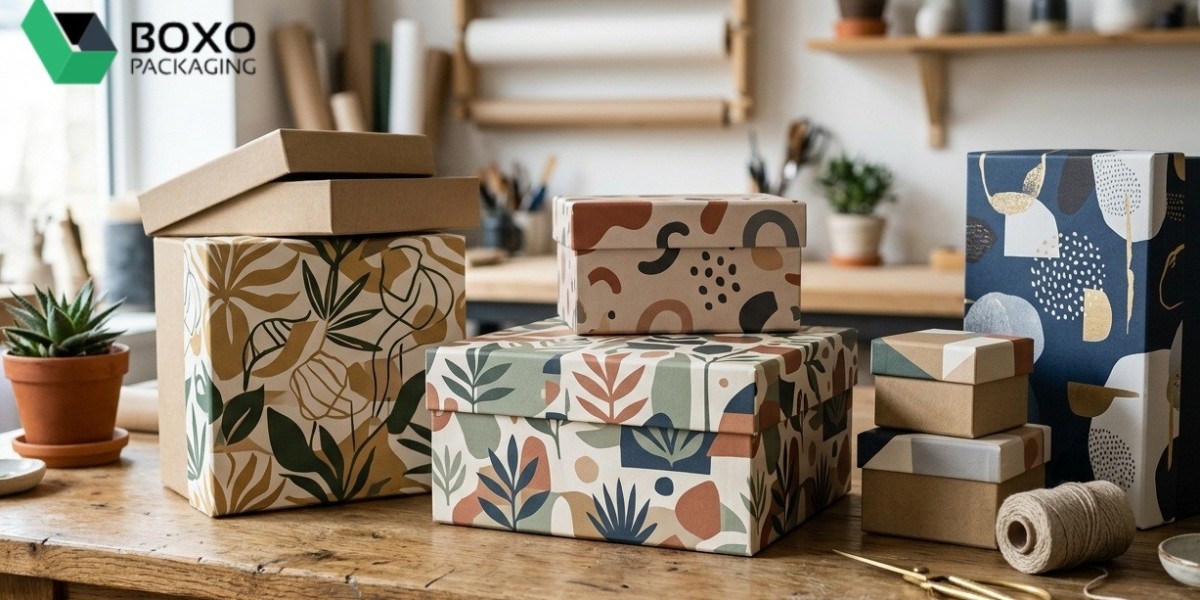

A wholesale box order can look like a great deal on the invoice and still cost a company money once it hits the loading dock, and the difference usually comes down to pallet math nobody checked beforehand. Custom Boxes Wholesale pricing looks straightforward, cost per unit times quantity, but the real cost lives in how efficiently those boxes actually stack, ship, and fit into a warehouse afterward. Gather Packaging's supply chain research found one packaging redesign improved pallet density by 40 to 50 percent, a single design change that reduced freight costs, material use, and handling complexity all at the same time. Boxesgen's logistics guide notes tertiary packaging, specifically pallet configuration and truck loading, often holds the largest untapped savings in high volume operations, sometimes 8 to 15 percent of total freight spend. Boxo Packaging walks wholesale buyers through exactly this math before finalizing an order, since the box price alone rarely tells the full cost story.
Why Does Custom Boxes Wholesale Pricing Depend So Much on Pallet Configuration?
Because a box that costs less per unit but wastes pallet space often ends up costing more overall once shipping and warehouse expenses get factored in. Custom Boxes Wholesale decisions made purely on unit price frequently miss this larger cost picture entirely.
NTT Data's supply chain research illustrates this with a concrete example, describing how one client reduced a frozen pizza box's dimensions by just 4 percent, a change invisible to consumers, yet it generated over 600,000 dollars in annual savings through reduced handling, storage, and transportation costs.
Adept Group's packaging optimization work shows similar results at scale. Their pallet and packaging SKU optimization projects generated 1.8 million dollars in annual savings for one growing CPG brand, and a separate project with a Fortune 500 client drove 6.23 million dollars in annual savings by identifying alternative packaging suppliers and requalifying production.
That kind of return isn't reserved for massive enterprise brands either. Zenpack's case study describes a client shipping three containers monthly from China who saved roughly 5,000 dollars per month simply by reducing box and shipper size to fit more product onto each pallet and container.
How Should a Wholesale Buyer Actually Evaluate Custom Boxes Wholesale Beyond Just Price Per Unit?
By checking how the box interacts with pallet dimensions, truck loading, and dimensional weight pricing, not just the quoted cost per box. Custom Boxes Wholesale buyers who skip this step often discover the real cost only after freight bills start arriving.
Gather Packaging's logistics research points directly to dimensional weight pricing as a hidden cost driver, noting carriers like UPS and FedEx charge based on whichever is greater, actual weight or dimensional weight, which means an oversized box shipped for a lightweight product can cost as much to send as a genuinely heavy one.
EcoPackables' warehouse optimization research found companies switching from pre-assembled boxes to flat-pack mailer formats saw space utilization improvements ranging from 30 to 40 percent, a meaningful gain given that logistics costs already consume nearly 9 percent of US GDP according to the same research.
TricorBraun's cost reduction guidance ties this back to a simple principle worth remembering, lighter, better sized packaging reduces material costs, lowers shipping expenses, and improves pallet efficiency simultaneously, resulting in more units per shipment and fewer total deliveries needed.
A quick checklist worth running before finalizing a custom boxes wholesale order:
- Confirm box dimensions actually optimize pallet stacking, not just individual unit cost
- Check dimensional weight pricing against actual product weight before finalizing size
- Ask suppliers about standardized dimensions that reduce warehouse handling complexity
- Factor tertiary packaging, pallet and truck loading, into the total cost comparison
Why Do So Many Small and Mid Sized Businesses Still Rely on Carbonless Forms Instead of Digital Alternatives?
Because they solve an immediate, offline documentation need that a digital system genuinely can't replicate in the exact same moment. Carbonless Forms give a contractor, delivery driver, or retail clerk an instant duplicate record the second a transaction happens, no app, login, or signal required.
NCR Forms' industry overview notes a carbonless receipt book can be used across an enormously wide range of businesses, from retailers and distributors to law firms and nearly any client based or business to business service that needs a physical proof of transaction on the spot.
That range shows up clearly across supplier catalogs too. PrintIt4Less notes it prints custom carbonless forms specifically for trades and service businesses across all 50 states, covering receipt books, work orders, sales orders, purchase orders, and estimate forms, all built around the same core carbonless mechanism.
The Carbonless Forms educational guide adds a genuinely practical use case worth remembering too, small home based businesses use carbonless invoices from a supplier specifically to keep organized financial records without needing any digital bookkeeping system running alongside the transaction itself.
What Configurations Do Carbonless Forms Actually Come In, and Does the Number of Parts Matter?
Yes, meaningfully, and the right configuration depends entirely on how many copies a transaction actually needs to stay properly documented. Carbonless Forms typically come in 2 part, 3 part, or 4 part sets, and UPrinting notes the part count simply indicates how many copies each written form produces.
A basic 2 part configuration usually covers a merchant copy and a customer copy, which works fine for simple retail transactions. Contractors and service businesses handling more complex paperwork often move to 3 part forms specifically to keep an office copy alongside the merchant and customer copies.
VistaPrint's product specifications describe how the mechanism actually works in practice, the top sheet captures handwriting and transfers it onto subsequent sheets below it, with sheets typically attached using easy to tear glue that creates a clean, separable customer copy every time.
Are Carbonless Forms Actually More Cost Effective Than Digital Invoicing for Certain Businesses?
For specific use cases, genuinely yes, mostly where a transaction happens somewhere digital tools can't reliably reach. Carbonless Forms remain the more practical option for delivery drivers, field service technicians, and contractors working in locations without dependable connectivity.
Printing for Less notes suppliers now even offer 100 percent recycled paper carbonless forms specifically for businesses wanting to stay environmentally conscious while still producing the instant multiple copies a digital only workflow simply can't guarantee in every field situation.
Sequential numbering adds another practical layer worth mentioning too. UPrinting notes forms can include up to 5 digit sequential numbering, a feature that streamlines record keeping and data monitoring far more reliably than a handwritten form without any built in tracking system.
Boxo Packaging sees this pattern often with clients running mixed operations, part digital invoicing for office based transactions, part carbonless forms for anything happening out in the field, which keeps the business documented properly regardless of where a given transaction actually takes place.
Bringing Custom Boxes Wholesale and Carbonless Forms Together
Custom Boxes Wholesale and Carbonless Forms solve very different problems, one is about efficient product movement through a supply chain, the other is about reliable paper documentation at the exact moment a transaction happens, but both quietly reward the same underlying discipline, choosing the format that fits the actual operational reality rather than defaulting to whatever seems most modern or most familiar.
A wholesale buyer chasing the lowest per unit box price without checking pallet fit is making the same kind of narrow decision as a business assuming digital invoicing alone covers every transaction their field team handles. Both mistakes tend to surface as hidden costs later rather than obvious ones upfront.
Whether it's a distributor rethinking box dimensions to improve pallet density or a contracting business keeping carbonless forms in the truck for jobs where signal and screens aren't reliable, the smartest operational choices come from matching the tool to the actual working conditions. Teams like Boxo Packaging tend to walk through both conversations with exactly that lens, since the format that looks most efficient on paper doesn't always hold up once it meets the real logistics of daily operations.










