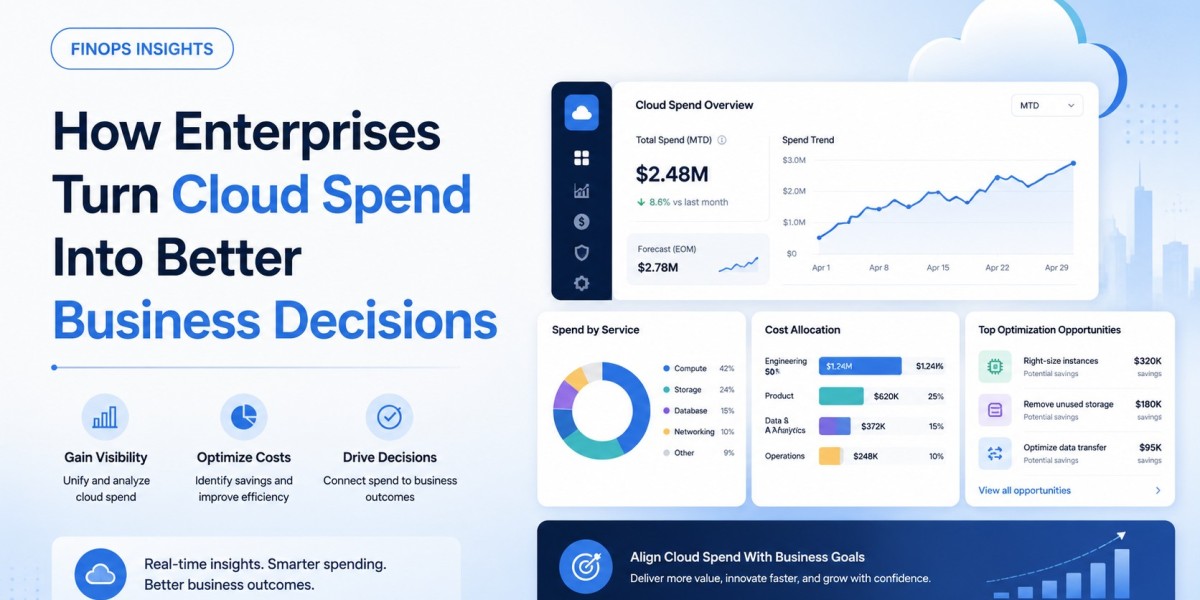

Cloud spending rarely gets out of control because of one dramatic mistake. More often, it grows through small decisions: an oversized database, idle development resources, unused storage, or commitments that no longer match demand. Finance sees budget variance; engineering sees infrastructure needed to keep products reliable. That gap is why FinOps Solutions have become essential. Modern FinOps is not simply about cutting cloud bills. It creates a shared model for understanding spend, assigning ownership, and deciding which costs support growth and which are waste. For AWS-focused organizations, CloudBuddi can support that process with cost intelligence, monitoring, and optimization insights.
Key Takeaways
FinOps Solutions work best when finance and engineering use the same cost data.
Visibility should come before optimization.
Good FinOps Software connects cost changes with owners, workloads, and business context.
FinOps Cost Optimization should focus on sustainable savings, not indiscriminate cost cutting.
Automation speeds analysis, but governance and accountable owners still matter.
Buyers should choose a FinOps Platform that fits their actual cloud architecture.
What Modern FinOps Solutions Need to Solve
The main cloud-finance problem is not lack of data. Most organizations already have dashboards and usage reports. The harder problem is turning that data into decisions.
A useful FinOps Management Platform should quickly answer practical questions: Which service caused the increase? Who owns it? Is the cost temporary or recurring? Is the resource overprovisioned? What happens to performance if the recommendation is applied?
That context matters. A high-cost production database supporting customer growth may be justified. An idle test instance running for three months probably is not.
This is where FinOps Cost Optimization differs from generic cost cutting. The goal is to improve cloud economics while protecting reliability, delivery speed, and customer experience.
Cost allocation is also fundamental. Mapping spend by account, team, project, application, or environment gives every cloud dollar an owner. Strong FinOps Solutions connect finance’s monthly view with engineering’s resource-level view.
How CloudBuddi Helps in FinOps Cost Optimization
CloudBuddi is designed for AWS-focused organizations seeking better visibility and cost control. Rather than treating cost management as a separate finance workflow, it brings cloud usage, cost intelligence, and optimization signals closer to engineering and operations.
Real-Time Visibility and Cost Monitoring Intelligence
Teams need to understand cloud spend during billing, not only after the invoice arrives. Centralized visibility across AWS accounts, services, projects, and environments helps teams see where costs are moving and who needs to investigate.
That is one role of cloud FinOps software: turning scattered billing data into a shared view.
Optimization Recommendations and Analytics
A useful Cloud Financial Management Platform should go beyond charts. It should help teams identify idle resources, rightsizing opportunities, unusual spending, and potential commitment savings.
The value of a Cloud FinOps Platform comes from context. “Spend increased” is useful; explaining why it increased and what is underused is more actionable.
Multi-Account AWS Management
CloudBuddi is better described as AWS-focused than as a broad multi-cloud product. For enterprises running primarily on AWS, consolidated multi-account visibility may be more useful than choosing a platform simply because it supports more providers.
Mini Example: From Findings to Real Savings
Consider a SaaS company spending $180,000 per month on AWS. A review identifies $10,000 in idle development resources, $13,000 in oversized compute, and $8,000 in possible commitment savings.
The company should not assume all $31,000 can be removed. Engineering may need some capacity for resilience, while finance may reject commitments that reduce flexibility. After review, the team approves $19,000 in recurring monthly savings.
That is a better example of FinOps cloud cost optimization than chasing the largest theoretical number: the savings are meaningful, technically safe, and sustainable.
What Good FinOps Software Should Deliver
Organizations comparing FinOps Software often focus on feature lists. A better buying approach is to evaluate the decisions a platform enables.
A strong Enterprise FinOps Platform should provide cost visibility, allocation, forecasting, anomaly detection, optimization recommendations, governance controls, and automation. It should also show enough technical context for engineers to judge risk before acting.
FinOps Automation Platforms are useful for budget checks, owner notifications, anomaly triage, and reporting. An AI powered FinOps platform can also prioritize opportunities faster.
Still, automation needs guardrails. High-impact infrastructure changes should remain tied to human decisions.
Common Mistakes in FinOps Cost Optimization
Monitoring Only at Month-End
Cloud environments change too quickly for monthly-only reviews. FinOps Solutions should help teams catch meaningful changes during billing.
Overprovisioning Without Reassessment
Extra capacity may be sensible during a launch or migration. The mistake is leaving temporary headroom untouched after demand normalizes.
Ignoring Alerts
Alerts have little value if nobody owns the response. Too many notifications create noise, while weak thresholds create false urgency.
Not Reviewing Usage Regularly
New services appear, old resources lose value, and commitments drift from actual demand. FinOps cloud cost management should be a recurring process, not an occasional cleanup exercise.
Future of FinOps Solutions
The next generation of FinOps Solutions will rely more on AI-assisted analysis, predictive analytics, and automated governance.
AI can help summarize cost changes, investigate anomalies, and prioritize savings opportunities. Predictive models can show where current usage trends may create future budget pressure. Automated governance can flag missing tags, unusual spend, or policy violations earlier.
FinOps is also expanding beyond basic cloud billing. Enterprises increasingly want technology-cost management that connects infrastructure, SaaS, AI workloads, and business value. The best FinOps platforms 2026 will be judged less by dashboard count and more by how effectively they help teams make accountable decisions.
Conclusion
FinOps Solutions are becoming the operating layer between cloud engineering and financial management. The strongest programs combine visibility, allocation, monitoring, optimization, governance, and automation without turning cost control into a barrier for engineering.
Whether an organization is evaluating FinOps Software, a Cloud FinOps Platform, FinOps automation software, or the best FinOps software for cloud cost optimization, the key question is simple: can it turn cost data into responsible action? For AWS-focused teams, CloudBuddi offers a practical path toward more continuous cloud financial management.
FAQs
What are FinOps Solutions?
FinOps Solutions are tools and operating practices that help organizations understand, allocate, monitor, forecast, govern, and optimize cloud spending while connecting finance, engineering, and business teams.
How do FinOps Solutions support cloud cost optimization?
They make cost drivers visible, assign ownership, identify waste, surface rightsizing opportunities, detect anomalies, and support recurring optimization workflows without blindly cutting resources.
What should enterprises look for in the best FinOps software?
Look for allocation, forecasting, anomaly detection, optimization recommendations, governance, automation, multi-account visibility, and reporting. The best FinOps platform for enterprise use should also fit the organization’s cloud architecture.
What is the difference between a FinOps Platform and a Cloud Financial Management Platform?
Cloud financial management usually emphasizes budgeting, allocation, reporting, and forecasting. A FinOps Platform typically extends into engineering collaboration, optimization workflows, governance, and operational accountability.
Can AI automate FinOps?
AI can automate anomaly investigation, reporting, recommendation prioritization, and workflow routing. Human judgment is still needed for changes that may affect reliability, commitments, or customer experience.