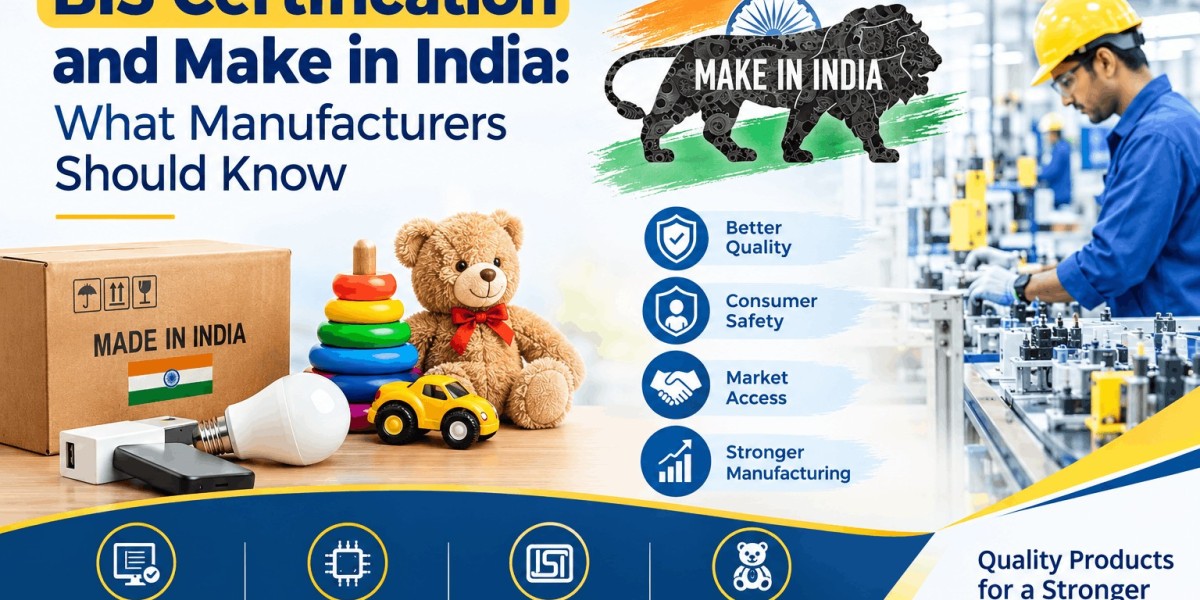

India is becoming a major manufacturing hub. The Make in India initiative encourages businesses to manufacture products in India, improve product quality, create jobs, and compete in both Indian and global markets.
As manufacturing grows, product quality and consumer safety have become more important. This is where the Bureau of Indian Standards (BIS) plays an important role.
For many products, manufacturers need to meet specific Indian Standards and obtain the required BIS approval or certification before selling them in the Indian market.
This guide explains the connection between BIS Certification and Make in India, the main requirements manufacturers should know, and how businesses can approach the certification process.
What Is BIS Certification?
The Bureau of Indian Standards (BIS) is India's national standards body. It develops standards for different products and provides certification schemes to help ensure that products meet specified quality and safety requirements.
Depending on the product and applicable standard, manufacturers may need certification under different BIS schemes.
A BIS certification can help demonstrate that a product complies with the relevant Indian Standard. For manufacturers, this can also support market access where certification is mandatory.
How BIS Certification Supports Make in India
Make in India focuses on increasing domestic manufacturing and making Indian products competitive.
BIS certification supports these objectives in several ways:
1. Promotes Product Quality
Manufacturers have to meet defined standards when a product is covered under a mandatory BIS requirement. This encourages better manufacturing and quality-control practices.
2. Improves Consumer Safety
Standards can address important areas such as product performance, electrical safety, construction, materials, and testing.
Compliance helps reduce the risk of products entering the market without meeting applicable safety and quality requirements.
3. Builds Consumer Confidence
Consumers are more likely to trust products that meet recognised quality standards. Where the BIS Standard Mark is permitted and applicable, it can provide an additional indication of conformity.
4. Helps Indian Manufacturers Compete
Meeting Indian Standards can help manufacturers build reliable products for the domestic market and prepare for wider market opportunities.
5. Encourages Better Manufacturing Systems
BIS certification may involve testing, factory evaluation, documentation, inspection, and ongoing compliance. These requirements can encourage manufacturers to maintain consistent production quality.
Is BIS Certification Mandatory for Every Product?
No.
BIS certification is not mandatory for every product manufactured or sold in India.
The requirement depends on the product, applicable Indian Standard, and the relevant government notification or BIS scheme.
Certain products are covered under compulsory certification or registration requirements. Other products may have voluntary certification options.
Therefore, manufacturers should first check whether their specific product falls under a mandatory BIS requirement.
BIS Certification for Indian Manufacturers
Manufacturers planning to produce products under the Make in India initiative should check BIS requirements during the product-planning stage rather than waiting until the product is ready for sale.
A manufacturer may need to consider:
Applicable Indian Standard
Product specifications
Testing requirements
Manufacturing facilities
Quality-control procedures
Required technical documents
Factory inspection, where applicable
Product samples
Applicable BIS scheme
Marking and labelling requirements
Ongoing compliance requirements
Early compliance planning can help reduce delays when launching a product.
What Is BIS Certification Online?
BIS Certification Online refers to the online process used for submitting applications and managing relevant BIS certification or registration activities.
Depending on the applicable scheme, the process may involve:
Identifying the applicable Indian Standard.
Checking whether certification is mandatory.
Preparing technical and manufacturing documents.
Getting product testing done through the applicable laboratory.
Submitting the application through the relevant BIS system.
Addressing queries or deficiencies, if raised.
Completing inspection requirements, where applicable.
Obtaining the applicable BIS licence or registration after fulfilling the requirements.
Maintaining compliance after approval.
The exact process varies according to the product and BIS scheme.
What Is BIS CRS Registration?
The Compulsory Registration Scheme (CRS) covers specified electronic and IT products.
Under CRS, manufacturers of notified products are required to comply with the applicable Indian Standard and complete the required registration process before placing covered products on the Indian market.
Products can include certain electronic and IT equipment notified under the scheme.
BIS CRS Registration Online
BIS CRS registration online involves submitting the required information and documents through the applicable BIS online system.
Manufacturers generally need to consider:
Product details
Applicable Indian Standard
Test reports from the required laboratory
Manufacturer information
Technical documents
Product photographs and specifications
Application details
Undertakings and declarations, where applicable
Manufacturers should verify the latest product coverage and requirements before applying because the list of products covered under compulsory schemes can change.
What Is ISI Certification?
The ISI Mark is associated with BIS product certification for products covered under the applicable BIS certification scheme.
For products under a mandatory BIS certification requirement, manufacturers may need to obtain a BIS licence and comply with the relevant Indian Standard before using the Standard Mark in the prescribed manner.
ISI Certification Online
Businesses searching for ISI Certification Online should first identify the correct Indian Standard and BIS product certification requirements.
The general process may include:
Selecting the applicable product standard
Reviewing the certification requirements
Preparing the manufacturing facility
Conducting required product testing
Preparing documents
Applying through the BIS system
Factory inspection, where applicable
Resolving observations or non-conformities
Obtaining the licence after meeting the requirements
Maintaining continuing compliance
The requirements can differ significantly from one product category to another.
BIS Certification for Toys
Toys are an important product category because children's safety is directly involved.
Manufacturers dealing with toys should check the applicable BIS requirements before manufacturing and selling covered products in India.
BIS Certification for Toys
BIS Certification for Toys is intended to ensure that toys covered by the applicable requirements meet relevant safety and quality standards.
Toy manufacturers may need to consider areas such as:
Mechanical and physical safety
Flammability
Migration of certain elements
Electrical safety for applicable toys
Material requirements
Product testing
Manufacturing controls
Labelling and marking requirements
Manufacturers should identify the applicable standard and testing requirements based on the type of toy being produced.
Documents Commonly Required for BIS Certification
The exact document list depends on the product and certification scheme. Common documents may include:
Manufacturer details
Factory address and manufacturing information
Product specifications
Product drawings
Technical documents
Test reports
Quality-control information
Details of manufacturing machinery
Details of testing facilities
Process flow chart
Raw material information
Trademark or brand-related documents, where applicable
Authorisation documents, where applicable
It is important to prepare documents according to the specific BIS scheme instead of using a generic checklist.
Common Mistakes Manufacturers Should Avoid
1. Applying Under the Wrong Standard
A product may have more than one relevant standard or may fall under a specific product category. Selecting the wrong standard can delay the process.
2. Ignoring Testing Requirements
Manufacturers should understand testing requirements before finalising their product specifications.
3. Using Incorrect Product Details
Product names, models, ratings, specifications, and technical information should remain consistent across the application, test reports, labels, and supporting documents.
4. Waiting Until the Product Launch
Starting BIS compliance at the last moment can create delays in product launch plans.
5. Ignoring Post-Certification Compliance
Obtaining a BIS licence or registration is not always the end of the compliance process. Manufacturers may have continuing responsibilities relating to production, testing, marking, surveillance, and renewal or validity requirements, depending on the applicable scheme.
How Corpbiz Can Help With BIS Certification
Manufacturers often find BIS requirements difficult because the process depends on the product category and applicable standard.
Corpbiz can assist businesses with the compliance process, including:
Identifying applicable BIS requirements
Documentation support
Application assistance
Testing coordination
BIS certification guidance
CRS registration assistance
ISI certification support
Toy certification support
Compliance-related guidance
Before starting the process, manufacturers should confirm the latest BIS requirements applicable to their specific product.
Why Manufacturers Should Plan BIS Compliance Early
The Make in India initiative has created opportunities for businesses across many manufacturing sectors. However, manufacturing a product is only one part of launching it successfully.
Quality, safety, testing, certification, labelling, and regulatory compliance should be considered from the beginning.
For products covered by mandatory BIS requirements, obtaining the appropriate approval or registration can be an important part of legally placing the product on the Indian market.
Early planning can help manufacturers:
Identify compliance requirements
Avoid unnecessary product changes
Prepare testing requirements
Organise technical documents
Reduce application delays
Plan product launches more effectively
Maintain ongoing compliance
FAQs on BIS Certification and Make in India
1. Is BIS certification mandatory for all manufacturers in India?
No. BIS certification is mandatory only for products covered under applicable compulsory requirements. Some products may also have voluntary BIS certification options.
2. What is the purpose of BIS certification?
BIS certification helps demonstrate that a product complies with the applicable Indian Standard under the relevant BIS certification scheme.
3. Can I apply for BIS Certification Online?
The applicable BIS application and registration processes are handled through BIS's online systems for relevant schemes. The exact procedure depends on the product and certification scheme.
4. What is BIS CRS registration online?
BIS CRS registration Online refers to the online registration process under the Compulsory Registration Scheme for specified electronic and IT products.
5. What is ISI Certification Online?
ISI Certification Online generally refers to the online application and related process for BIS product certification involving the Standard Mark, where applicable.
6. Is BIS Certification for Toys mandatory?
Certain toys are subject to mandatory BIS requirements. Manufacturers should check the latest applicable requirements for their specific toy category before placing products on the Indian market.
7. How long does BIS certification take?
The timeline varies depending on the product, testing, documentation, inspection requirements, queries, and the applicable BIS scheme. Therefore, manufacturers should not assume a fixed processing time for every product.
8. Can a manufacturer sell a product before getting mandatory BIS approval?
If the product is covered by a mandatory BIS requirement, the manufacturer must comply with the applicable legal requirements before placing the product on the market. The specific restrictions depend on the relevant order and scheme.
9. Does BIS certification improve product quality?
BIS certification involves compliance with specified standards and, depending on the scheme, testing and factory-related requirements. This can support consistent manufacturing quality, but certification itself should not be treated as a guarantee of every aspect of product performance.
10. How can Corpbiz help manufacturers?
Corpbiz can assist manufacturers with understanding applicable BIS requirements, documentation, testing coordination, application support, and certification-related compliance.
Conclusion
Make in India is creating new opportunities for manufacturers in India. At the same time, businesses need to pay close attention to product quality, safety, and regulatory requirements.
BIS certification can play an important role for products covered under mandatory or voluntary BIS schemes. Whether a business needs BIS Certification Online, BIS CRS registration Online, ISI Certification Online, or BIS Certification for Toys depends on the product and the applicable requirements.
Manufacturers should identify the correct Indian Standard and BIS scheme before starting production and market launch activities. Proper planning can help businesses build compliant products and create a stronger foundation for long-term growth.
Author Profile
Written by Atul Shukla
Atul Shukla is a legal and compliance professional associated with Corpbiz Advisors. He writes about business registrations, regulatory compliance, certifications, taxation, and legal requirements for Indian businesses. His content focuses on providing practical and easy-to-understand information to entrepreneurs, manufacturers, startups, and established businesses.