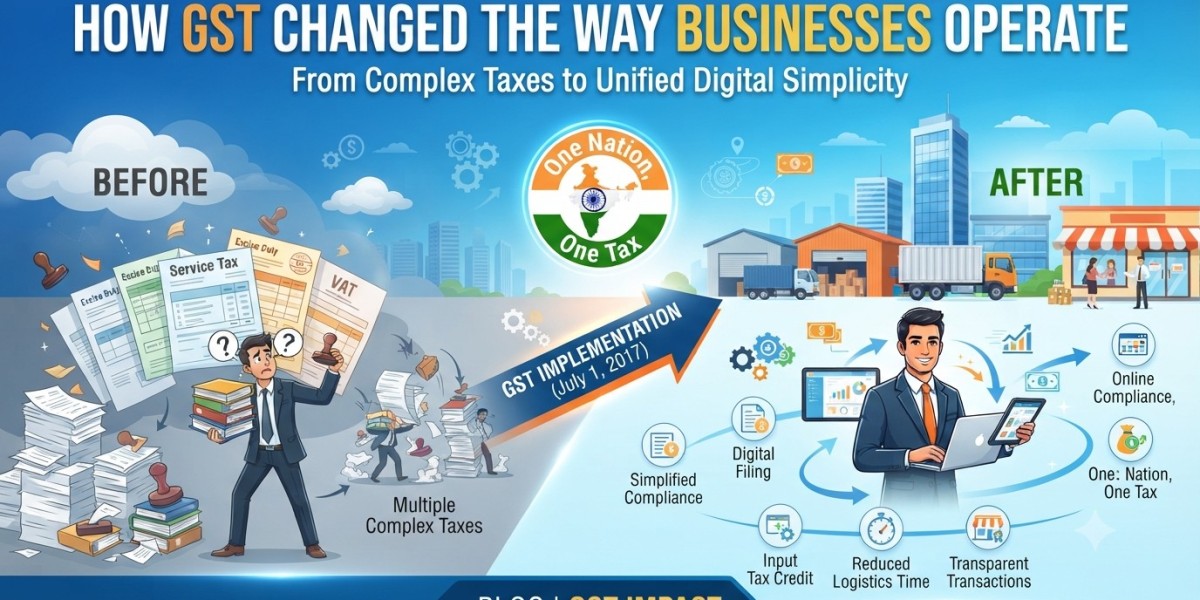

The introduction of the Goods and Services Tax (GST) changed the way businesses manage their taxes, invoices, sales, purchases, and compliance. Before GST, businesses had to deal with several indirect taxes at different stages. GST brought many of these taxes under one system and created a common tax framework across India.
Today, GST is an important part of daily business operations. From issuing invoices to maintaining purchase records and filing returns, businesses need to consider GST at different stages of their operations.
Digital services have also made compliance easier. Businesses can use Online GST Registration, GST Return Filing Online, accounting software, and other digital tools to manage their tax responsibilities.
This article explains how GST changed business operations and what businesses need to keep in mind.
What Is GST?
GST, or Goods and Services Tax, is an indirect tax charged on the supply of goods and services in India. It replaced several earlier indirect taxes, including VAT, service tax, and excise duty in many cases.
GST is based on the destination principle, meaning tax revenue generally goes to the state where goods or services are consumed.
Businesses involved in taxable supplies may need to register under GST depending on their turnover, nature of business, and other applicable conditions.
How GST Changed Business Operations
GST did not only change the tax system. It also affected several regular business activities.
1. Businesses Moved to a More Unified Tax System
Before GST, businesses had to understand different indirect tax laws applicable at the central and state levels.
GST created a more unified framework for indirect taxation. Businesses now need to understand concepts such as:
GST registration
GSTIN
Tax invoices
Input Tax Credit
GST returns
E-way bills
E-invoicing, where applicable
GST payments
This has made tax compliance an important part of regular business planning.
2. Online GST Registration Became an Important Business Step
Businesses that are required to register under GST need to complete the registration process through the GST system.
Online GST Registration has made the process more accessible because businesses can submit information and documents electronically.
After registration, an eligible business receives a GST Identification Number (GSTIN), which is used for GST-related transactions and compliance.
Businesses should check whether GST registration is mandatory for their particular activities instead of assuming that every business follows the same threshold.
3. Invoicing Became More Structured
GST changed the way businesses prepare invoices.
A GST tax invoice generally contains important details such as:
GSTIN of the supplier
Customer details, where applicable
Invoice number and date
Description of goods or services
Taxable value
Applicable GST rate
CGST, SGST/UTGST or IGST, as applicable
Total invoice value
This has encouraged businesses to maintain better sales and purchase records.
4. Input Tax Credit Changed Purchase Decisions
Input Tax Credit (ITC) is one of the important features of GST.
Subject to applicable conditions and restrictions, a registered business may claim credit for eligible GST paid on purchases and business expenses against its output GST liability.
Because of this, businesses need to pay greater attention to purchase invoices, supplier details, and GST records.
For many businesses, choosing compliant suppliers and maintaining proper documentation has become an important part of financial management.
5. GST Return Filing Became a Regular Compliance Activity
GST requires registered taxpayers to file applicable returns or statements according to the relevant rules and taxpayer category.
GST Return Filing Online has become a regular compliance activity for many businesses.
Businesses need to maintain accurate records of:
Sales
Purchases
Input tax credit
Output tax
Credit and debit notes
Tax payments
Other relevant transactions
Incorrect information can create reconciliation problems and may affect tax compliance.
6. Businesses Started Using More Digital Accounting Tools
GST encouraged many businesses to move from manual records to accounting and compliance software.
Modern accounting systems can help businesses track:
Sales invoices
Purchase invoices
GST calculations
Input tax credit
Tax liabilities
Customer and supplier information
Return-related data
Digital records can also make it easier for businesses and professionals to identify errors before filing returns.
7. E-Commerce and Inter-State Business Became Easier to Manage
GST created a common tax framework for businesses operating across different states.
Businesses selling products or services outside their state need to understand the applicable GST treatment, including the difference between intra-state and inter-state supplies.
This has been particularly relevant for businesses that sell through e-commerce platforms or operate across multiple locations.
8. E-Way Bills Added Another Compliance Layer
The GST system also introduced e-way bill requirements for certain movement of goods, subject to applicable rules and exemptions.
Businesses involved in the transportation of goods need to ensure that required documentation is available before movement.
This has made logistics and tax compliance more closely connected.
9. GST Made Record Keeping More Important
GST compliance depends heavily on accurate business records.
Businesses should maintain proper records of their transactions and supporting documents. Good record keeping helps with:
GST return preparation
Input tax credit reconciliation
Tax payments
Financial reporting
Tax assessments
Business decision-making
Small errors in invoices or accounting records can create problems later, so regular reconciliation is useful.
GST Also Changed the Role of Tax Professionals
GST increased the need for professionals who understand taxation, accounting, and compliance.
Many businesses now seek professional assistance for GST registration, return filing, reconciliation, notices, and other compliance requirements.
Tax professionals may also help businesses coordinate GST compliance with other statutory requirements, such as income tax and TDS.
For example, businesses may use Income Tax Return Filing Services to manage their income-tax compliance and TDS Return Filing Online services for applicable TDS reporting.
GST and Business Planning
GST is now connected with several business decisions.
Businesses may consider GST implications when deciding:
Where to maintain business operations
How to structure invoices
How to select suppliers
How to price products or services
How to manage inventory
How to expand into another state
How to maintain accounting records
Therefore, GST should not be treated only as a tax filing activity. It can affect regular financial and operational decisions.
How Small Businesses Can Manage GST Better
Small businesses can follow a few basic practices to reduce compliance problems:
Maintain Accurate Records
Record sales, purchases, expenses, and tax information regularly rather than waiting until the filing deadline.
Check Invoices
Verify GSTIN, invoice numbers, tax rates, taxable values, and other important information.
Reconcile Regularly
Compare accounting records with GST-related data to identify differences early.
Track Compliance Dates
Keep a calendar for GST returns, TDS returns, income-tax requirements, and other applicable filings.
Use Digital Accounting Tools
Accounting and compliance software can reduce manual work and help maintain organised records.
Take Professional Advice When Required
Businesses with complex transactions, multiple registrations, interstate operations, or large volumes of invoices may benefit from professional tax and compliance support.
How Corpbiz Helps Businesses With Compliance
Corpbiz provides compliance and business support services for entrepreneurs, startups, companies, and other organisations.
Businesses can seek professional assistance for services such as Online GST Registration, GST compliance, GST Return Filing Online, income-tax compliance, and TDS Return Filing Online.
Corpbiz Advisors works with legal and tax professionals to help businesses manage their regulatory requirements and maintain proper compliance records.
Frequently Asked Questions
1. How did GST change businesses in India?
GST created a common indirect tax framework and changed how businesses handle invoicing, input tax credit, accounting, tax payments, and return filing.
2. Is Online GST Registration mandatory for every business?
No. GST registration depends on factors such as turnover, nature of supplies, business activities, and other conditions prescribed under GST law.
3. What is GST Return Filing Online?
GST Return Filing Online is the electronic process of submitting applicable GST return information through the GST system, generally based on the taxpayer's registration type and applicable requirements.
4. Why is input tax credit important?
Eligible input tax credit can allow a registered business to claim credit for GST paid on qualifying purchases, subject to applicable conditions and restrictions.
5. How does GST affect small businesses?
GST can affect invoicing, pricing, accounting, purchases, sales, record keeping, and tax compliance. The exact impact depends on the business's size and activities.
6. What are Income Tax Return Filing Services?
Income Tax Return Filing Services help individuals and businesses prepare and submit their applicable income-tax returns and related information.
7. What is TDS Return Filing Online?
TDS Return Filing Online refers to the electronic submission of applicable TDS statements by deductors according to the prescribed requirements.
8. Can GST compliance be managed through accounting software?
Yes. Accounting and GST software can help businesses maintain invoices, calculate taxes, track transactions, reconcile records, and prepare information required for compliance.
9. Does GST apply to interstate transactions?
GST treatment depends on the nature and location of the supplier and recipient and the type of supply. Interstate supplies are generally subject to IGST, subject to applicable provisions.
10. Why should businesses maintain proper GST records?
Proper records can help businesses prepare returns, reconcile transactions, support eligible input tax credit claims, respond to tax queries, and maintain better financial control.
Conclusion
GST changed more than the way businesses pay indirect taxes. It influenced invoicing, accounting, purchasing, sales, logistics, record keeping, and tax compliance.
The growing use of online compliance systems has also changed how businesses manage their statutory responsibilities. Services such as Online GST Registration, GST Return Filing Online, Income Tax Return Filing Services, and TDS Return Filing Online can help businesses manage different compliance requirements with professional support.
For businesses, the key is to maintain accurate records, understand applicable GST requirements, monitor filing obligations, and seek professional assistance when needed.
Author Profile
Atul Shukla
Legal Advisor – Corpbiz Advisors
Atul Shukla is a legal and compliance professional associated with Corpbiz Advisors. He writes about GST, business compliance, taxation, company laws, registrations, and regulatory requirements to help businesses understand complex compliance topics in simple language.











